How Foreign Buyers Actually Finance Property in Mexico
Mexican mortgages, cross-border lenders in dollars, developer payment plans and home equity. What each really costs, and why most buyers still pay cash.
Carlos Mendoza
Senior Real Estate Advisor
The question arrives early in almost every conversation. Can I get a mortgage? The honest answer is yes, several ways, and most people end up not using any of them. Understanding why is more useful than a list of lenders.
Why cash dominates
Industry estimates put the share of foreign buyers who complete without a Mexican mortgage above ninety percent. That figure comes from the sector rather than from an official statistical body, so treat it as directional. But the direction is not in doubt, and the reason is arithmetic.
Mexican mortgage rates sit near ten percent. Banxico, the central bank, cut its reference rate to 6.50 percent in late June 2026 and has been easing gradually, yet mortgage rates have stayed stubbornly close to ten. Long-term rates have not followed the policy rate down, partly because of the structure of Mexico's formal labour market.
An American buyer with a home equity line at seven percent, or a Canadian refinancing at a comparable rate, is looking at Mexican financing that costs meaningfully more, requires more paperwork, and in many cases requires residency they do not have. So they use capital from home and buy outright.
The four routes, honestly compared
1. A Mexican bank mortgage
BBVA, Santander, Scotiabank, HSBC and Banorte all lend to foreign nationals in principle. In practice they lean heavily toward applicants who hold temporary or permanent residency, and the file is demanding: income documentation, Mexican tax ID, credit history they can assess.
Expect peso-denominated rates in the nine to fourteen percent range, with something around ten to eleven and a half realistic for the rest of 2026. Loan to value typically runs fifty to seventy percent, meaning a down payment of thirty to fifty percent.
Who this suits: buyers who already hold residency, earn in pesos, or intend to live in Mexico full time. The peso denomination is an advantage if your income is also in pesos, and a risk if it is not.
2. A cross-border lender in dollars
A small number of US-based specialists write mortgages on Mexican property, denominated in dollars, for American citizens. MoXi, operating as Global Mortgage, is the most established.
Typical terms: loans from 250,000 to 2.5 million dollars, up to sixty five percent of appraised value so a minimum down payment near thirty five percent, a credit score requirement around 700, rates in the high eights to low tens, and fixed terms up to thirty years.
Who this suits: American buyers who want leverage, do not want to touch their home equity, and value dollar denomination. The rate is better than a Mexican bank and the process is familiar. Note this is a narrow market with few providers, so shop it properly.
3. Developer financing on pre-construction
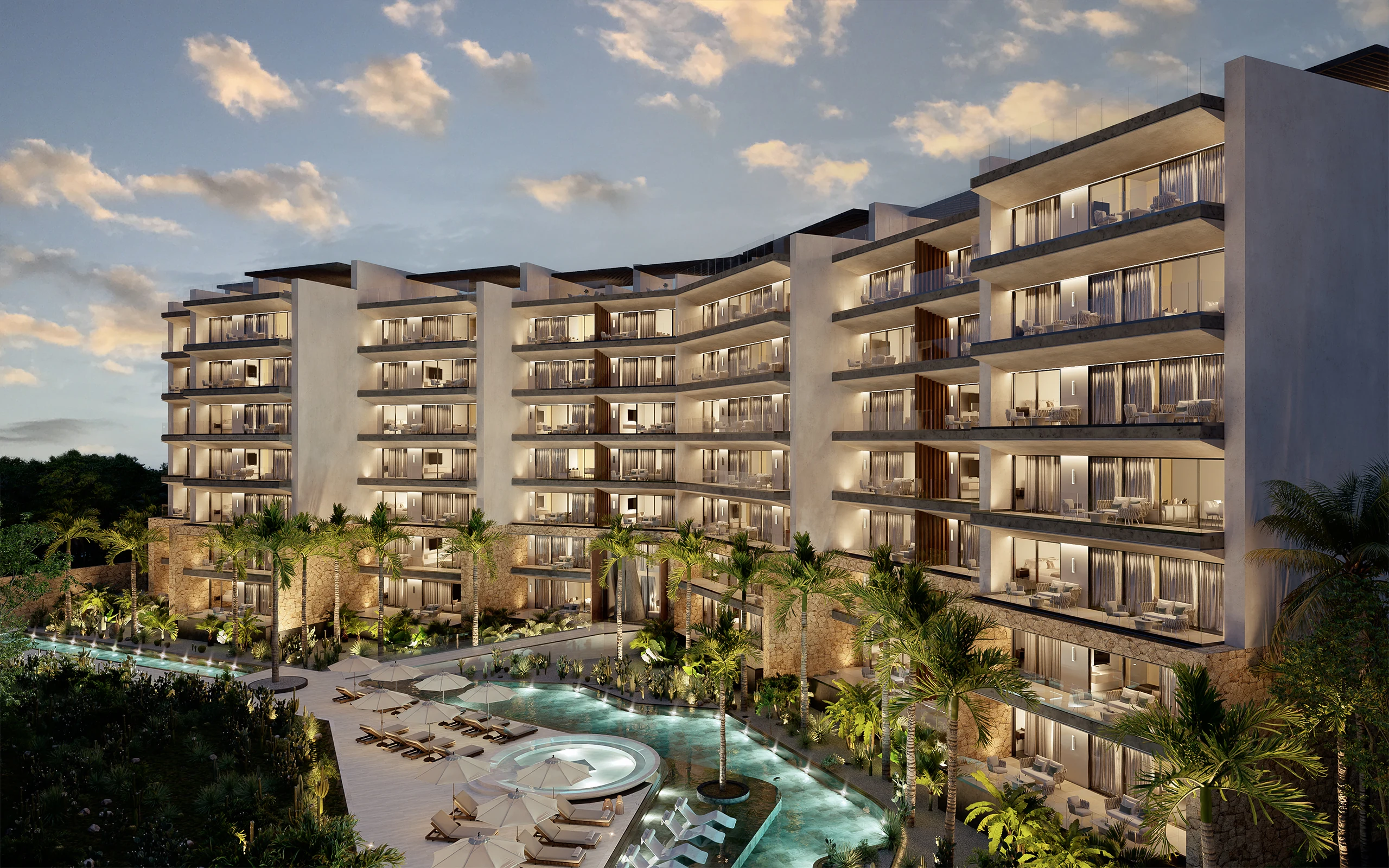
This is by far the most used option in the Riviera Maya and the Yucatán coast, and it is the one most buyers do not think of as financing at all.
The common structure is thirty percent on signing, sixty percent in instalments through construction, and the final ten percent on delivery. A frequent alternative is fifty percent down with the balance spread interest free over twelve months. Across the market, down payments run thirty to fifty percent, terms twelve to sixty months, and where interest is charged it tends to land between eight and twelve percent.
The interest-free variants are real, not a gimmick. The developer is funding construction with your payments rather than with bank debt, and pricing that benefit into the deal.
Who this suits: buyers comfortable with delivery risk who want to spread payments without a credit application. The trade-off is that you are exposed to the developer completing on time, which makes the developer's track record the thing you are actually underwriting. It is why we research and publish the developer behind every pre-construction listing we carry.
4. Home equity from your own country
Borrowing against a property you already own in the United States or Canada, then buying in Mexico with the proceeds, is the most common path in practice.
The advantages are obvious: a lower rate, a lender who already knows you, no residency requirement, and you arrive in Mexico as a cash buyer, which is worth real negotiating leverage.
The risks deserve equal billing. Your home country property secures the debt, so a problem with the Mexican purchase becomes a problem with the house you live in. Home equity lines usually carry variable rates. And you are converting a paid-down asset into a leveraged one at a stage of life when many buyers are trying to do the opposite.
None of that makes it wrong. It makes it a decision to take deliberately rather than by default.
The currency question
Legally, the deed is executed and the final payment settled in pesos, even when the price was negotiated in dollars. That creates exposure at two points: while you negotiate, and again at conversion on closing day.
The magnitude is not theoretical. Between 2022 and April 2024 the peso strengthened from roughly 21.9 to 16.3 per dollar, close to twenty five percent. A property priced in pesos became materially more expensive for a dollar buyer over that window, through no change in the property itself. Some sellers now build a volatility cushion into dollar prices to protect themselves, which is worth recognising when you assess a quote.
If you are converting a large sum, talk to a currency specialist rather than accepting your bank's retail rate. On a purchase in the hundreds of thousands, the spread is not a rounding error.
What we suggest people work out first
Before comparing rates, settle three questions.
Will you hold residency? If yes, Mexican bank financing opens up. If no, you are realistically choosing between a cross-border lender, developer terms, or capital from home.
Where does your income come from? Peso debt against dollar income is a currency bet layered on top of a property purchase. Sometimes that is fine. It should be deliberate.
Pre-construction or finished? Developer terms only exist on the former. If you want a finished property and need leverage, you are looking at a cross-border lender or home equity.
Worth adding that Mexican buyers, who make up a significant share of the market in Mérida and along the Yucatán coast, navigate this differently. They have access to domestic mortgage products and to Infonavit, and their calculation is not the same as a foreign buyer's. If you are a Mexican national reading this, most of the constraints above do not apply to you.
You can see current pricing across our markets in the full portfolio, and each pre-construction listing states the developer and delivery date so you can weigh the terms against who is offering them.
This article is general information, not financial advice, and we are not licensed financial advisors. Rates and lender criteria change frequently. Verify current terms directly with lenders and speak to your own financial advisor before committing.