Is the Riviera Maya Safe? What the Data Actually Says
An honest look at safety in Tulum, Playa del Carmen, Cancún and Mérida using advisory levels, homicide rates and crime indexes, including the parts most agencies leave out.
Carlos Mendoza
Senior Real Estate Advisor
This is the question buyers ask last, quietly, after the tour is over and the paperwork looks fine. It is also the question almost nobody in this industry answers with numbers. Search it and you will find travel blogs, forum threads and a lot of reassurance from people with something to sell. So here is our attempt at the opposite: the actual figures, including the ones that do not flatter us.
Two things are true at the same time. Yucatán is statistically one of the safest places in North America, safer by the numbers than most American cities buyers are moving from. And Tulum has had a genuinely difficult two years. Both facts matter, and treating either one as the whole story would be dishonest.
What the governments actually say
The United States State Department rates travel risk on a four-level scale, updated per Mexican state rather than for the country as a whole. That distinction matters enormously, because Mexico is not one place.
Yucatán state, which includes Mérida, Progreso and the Yucatán coast, sits at Level 1: Exercise Normal Precautions. That is the lowest rating the State Department issues. Only two of Mexico''s thirty-two states hold it, and Yucatán is one of them. Level 1 is the same rating given to Japan, Iceland and Switzerland.
Quintana Roo, which includes Cancún, Playa del Carmen, Tulum and Cozumel, sits at Level 2: Exercise Increased Caution. For context, Level 2 is also the rating currently applied to Spain, France and Italy. It is the most common rating in the world and it does not mean avoid travel. It means pay attention, which is reasonable advice anywhere.
The Government of Canada places Mexico as a whole at its second tier, advising a high degree of caution due to criminal activity, without any recommendation to avoid Quintana Roo or Yucatán specifically.
What neither government does is tell you to stay away from the places we sell in. What they also do not do is pretend the risk is zero.
The number that surprises most buyers
Mexico''s national homicide rate runs at roughly 12.9 per 100,000 residents. That figure is the one that drives headlines, and it is real.
Yucatán''s rate in 2025 was 1.03 per 100,000. The state recorded thirty-three intentional homicides across the entire year, in a population of well over two million. That is the lowest rate of any Mexican state, roughly twelve times below the national average, and it has held in that range for five consecutive years: 1.76 in 2021, 1.61 in 2022, 1.39 in 2023, 1.77 in 2024, and 1.03 in 2025.
To put that in the frame most of our buyers are actually using: the United States as a whole runs several times higher than Yucatán. A retiree moving from a mid-sized American city to Mérida is, in the plainest statistical terms, moving somewhere safer than where they came from. That is not a sales line. It is what the numbers say, and it is why Mérida keeps appearing on lists of safest cities in the Americas.
Crime perception, city by city
Numbeo compiles a crime index from resident surveys. It measures perception rather than reported crime, so treat it as a sense of how people feel rather than a legal statistic. Still, the comparison is instructive because it uses the same method everywhere.
- Mérida: 23.9 (safety index 76.1)
- Tulum: 36.5
- Toronto: 43.7
- Playa del Carmen: 46.2
- Cancún: 54.6
- Chicago: 65.3
- Baltimore: 71.0
- Memphis: 77.7
Mérida scores better than Toronto. Playa del Carmen and Cancún score worse than Toronto but well below Chicago, Baltimore or Memphis. Tulum sits between Mérida and Toronto on perception, which will surprise anyone who has only read the headlines.
The part about Tulum we are not going to skip
Tulum has had real problems, and any agency telling you otherwise is either uninformed or hoping you are.
Since late 2024 there have been several violent incidents in and around the town. A beach club shooting in December 2024 killed two people, including an American woman. The municipal security chief was killed during an operation in La Veleta in March 2025. A bar on Avenida Tulum was attacked in August 2025 with three dead. In January 2026 an Argentine visitor was killed in a shooting at a cenote during a music festival.
The context reported consistently by Mexican press is a territorial dispute between rival criminal organizations over control of the area. In the verified cases, the victims were not targeted as tourists, residents or property owners. The American woman killed in 2024 was caught in crossfire between groups, which is a distinction that matters analytically and not at all to her family.
The market has responded. Tulum hotel occupancy fell from 66.7 percent in September 2024 to 49.2 percent in September 2025. That is a serious drop and it has affected short-term rental performance, resale timelines and negotiating leverage across the town. If you are looking at Tulum, you should know that going in, because it is currently a buyer''s market for reasons that are not entirely happy ones.
None of this means Tulum is off the table. It means Tulum requires a clearer head than it did three years ago, and that the euphoric projections some sellers were making in 2022 have not aged well.
How this actually changes what people buy
In practice, safety shows up in purchase decisions in three ways, and none of them involve avoiding Mexico.
Location within a destination, not the destination itself
The gap between neighborhoods inside a single city is usually wider than the gap between cities. In Playa del Carmen, Playacar behaves nothing like the areas well west of the highway. Established gated communities such as Playacar, Puerto Aventuras, Mayakoba and Corasol operate controlled access around the clock, and buyers who prioritize security concentrate there. In Mérida, the northern corridor and the restored centro both read as calm, but for different reasons and to different kinds of buyers.
Full-time living versus part-time ownership
A property you occupy three weeks a year and a property you live in have different requirements. Absentee owners tend to want a building with staffed access and neighbors present year round rather than an isolated villa. Full-time residents weigh schools, hospitals and everyday walkability more heavily, which is a large part of why Mérida has drawn the permanent-relocation crowd while the coast has drawn the seasonal one.
Yucatán as the quiet alternative
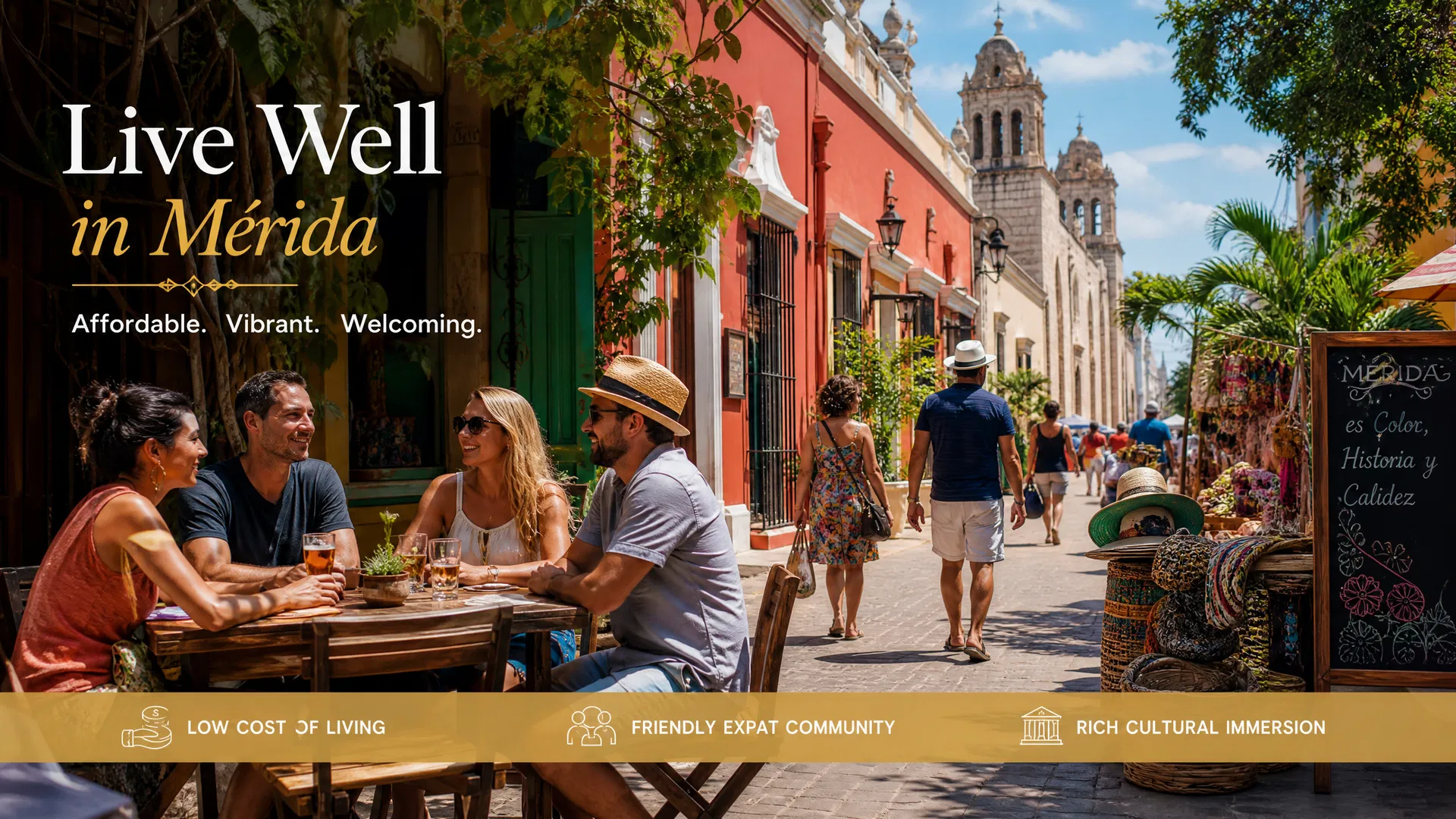
A meaningful share of the buyers we work with started their search in Tulum and finished it in Mérida or on the Yucatán coast. They did not necessarily start out looking for the safest option; they were usually looking for value or for a slower rhythm, and safety turned out to be part of the same package. Progreso, Chicxulub and Telchac Puerto are inside a state with a homicide rate near one per hundred thousand, at prices that in many cases are below comparable coastal product in Quintana Roo.
What we tell people who ask us directly
Read the advisory for the specific state, not the country. Visit before you buy, ideally more than once and not only during high season. Talk to people who already own there, and ask them what they wish they had known. Look at where the property sits relative to the areas locals avoid, which is information any honest agent can give you in about thirty seconds.
And weigh the question the way you would weigh it at home. Nobody moving within the United States researches homicide statistics before choosing a suburb, but everyone considering Mexico does, which produces a comparison that is not really apples to apples. The relevant question is not whether Mexico is safe in the abstract. It is whether this specific neighborhood, in this specific city, is safer or less safe than where you live now. In Yucatán, for most American and Canadian buyers, the honest answer is that it is safer.
Mexican buyers, who make up a substantial part of the market in Mérida and along the Yucatán coast, have understood this for a long time. They have been buying second homes on that coast for generations, largely for the same reasons foreign buyers are now discovering.
Our agents are state-certified in Quintana Roo and we hold NAR membership, which means our obligation is to give you the accurate picture rather than the comfortable one. If a location is wrong for what you want, we would rather say so before you buy than after.