Power, Water and Internet: What Reaches the Property
Power, water, sewer and internet change street by street on the Yucatan peninsula. What to verify at the lot before you sign, and what it costs in 2026.
María Elena Canul
Lifestyle & Relocation Specialist
Most buyers study the view, the finishes and the price per square foot. Services get a glance at the end, usually one question about whether the internet is any good. That is the wrong order. On the Yucatán peninsula, what actually reaches a lot (power at a subsidized rate or not, water from which utility, a sewer connection or a tank in the garden, a fiber line or no line) changes street by street. It is also the part of a purchase that is hardest to fix once you own it.
Here is what to check, and what the numbers looked like in late 2026.
Electricity has a cliff built into it
Residential power comes from CFE and is subsidized, as long as the account stays under a consumption limit. Go over it and the account is reclassified to the DAC tariff, the Tarifa Doméstica de Alto Consumo, which carries no government subsidy at all.
The limits are set per locality and run in a ladder by tariff category: 250 kWh a month on tariff 1, 300 on 1A, 400 on 1B, 850 on 1C, 1,000 on 1D, 2,000 on 1E and 2,500 on 1F, according to figures published by Diario de Yucatán in May 2026. The hot and humid coast sits in the upper brackets rather than at the 250 kWh floor, but the only way to know your category is to read the bill, which prints it.
On DAC, the same newspaper reported a fixed charge of 145.24 pesos plus energy at roughly six to seven pesos per kWh depending on the region. Two details matter more than the rate. The switch is not triggered by one hot month, because CFE looks at the average of the last twelve. And getting back off DAC takes twelve consecutive months under the limit plus a request to CFE: it is not automatic, and nobody does it for you.
So ask for the last twelve CFE bills, not one.
What the bill tells you before you buy
- Whose name is on the account, and whether a balance is owed. Debt follows the meter, not the person.
- The tariff category, and whether the account already sits on DAC.
- Twelve months of consumption, which is the only honest preview of your own bills.
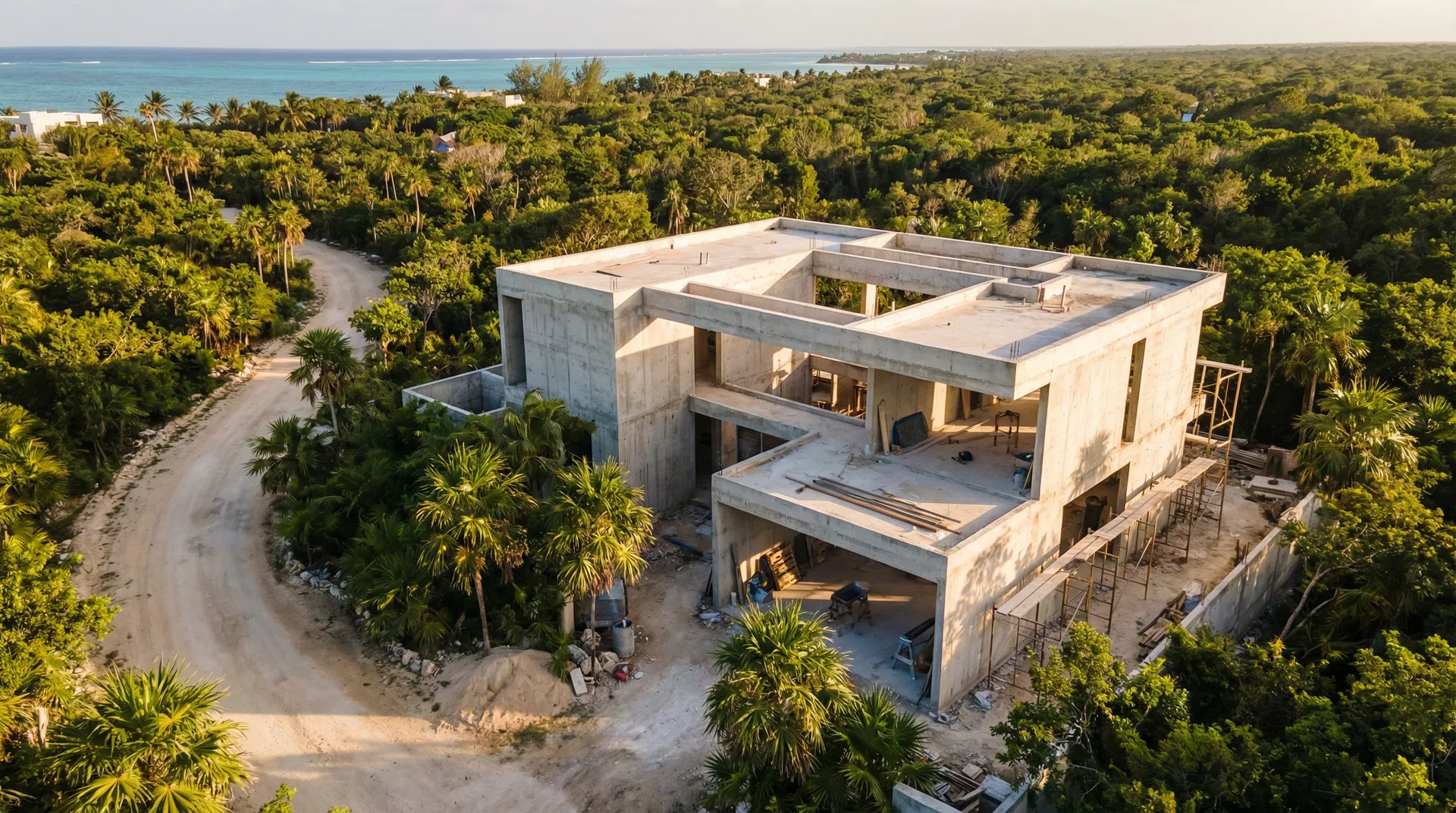
- Whether the lot is connected at all. On raw land, bringing in service means poles, and the cost depends on the distance to the nearest line. Get that quoted before you buy, not after.
Your water utility depends on the municipality
In Quintana Roo there is no single provider. A private concession, Aguakan, holds water and sewer service in four municipalities: Benito Juárez (Cancún), Isla Mujeres, Puerto Morelos and Solidaridad (Playa del Carmen). The rest of the state is served by the state commission, CAPA. The concession is also contested: in October 2025 CAPA's director said publicly that the commission was ready to take over those four municipalities once the legal proceedings concluded. Service has not changed hands, but the arrangement is not settled.
In Yucatán the provider is JAPAY, the state water board. In Mérida the domestic minimum charge was 103 pesos for consumption of zero to 20 cubic metres, and the commercial minimum 249 pesos for zero to 30, figures JAPAY's director gave in March 2025. That same interview put the number of faulty meters in the city at around 48,000, which is why bills estimated rather than measured are a common complaint. Confirm that the meter on the house you are looking at actually works.
Sewer is the question nobody asks
Connection to a municipal network is not the default on this coast. In Tulum, the president of the local hotel association said in 2023 that the drainage network served barely 54 percent of the population. That figure is a few years old and comes from an industry voice rather than a census, but the direction is not in dispute: a large share of homes rely on septic tanks, biodigesters or injection wells.
That is not automatically a problem, because a properly sized and maintained system works. What matters is knowing which one you are buying: where the tank sits, when it was last pumped, who pumps it, whether it matches the permit the development was built under, and whether the municipality has any plan to run a line down your street. Over a limestone aquifer this is also the part of the house carrying the most environmental exposure, and the part a future regulation is most likely to touch.
What comes out of the tap
The peninsula sits on limestone, so groundwater is hard. The consequences show up in appliances, fixtures and pool chemistry rather than in the contract. Most households filter or purify drinking water and many install a softener. Houses are generally built with a cistern and a roof tank, so that an interruption in the municipal supply is not an interruption in the house. Confirm that rather than assume it: ask where the cistern is, what it holds, and when it was last cleaned.
Internet: check the address, not the neighborhood
Fiber coverage is decided address by address. A neighbor with a fast line proves nothing about your lot, and a development's brochure proves less. Ask which provider serves the house, ask to see a recent bill, and run the exact street address through that provider's own coverage check before you sign.
Where no line reaches, satellite is the realistic fallback. Mexican price trackers listed Starlink's residential plans in mid November 2026 at about 1,050 pesos a month for Residencial Lite and 1,350 for Residencial Max, with a roaming plan at 950 pesos for 100 GB, and the hardware kit at 3,499 pesos. Plans advertise up to 150 Mbps, which is a ceiling rather than a guarantee, and Starlink revises its Mexican pricing often, so treat those as a snapshot. In a condominium, ask what the maintenance fee covers and whether the building is wired for more than one provider.
Renting it out changes your contracts
If the plan involves a short-term rental platform, the utility side changes with it. In Yucatán, JAPAY has told hosts who rent homes or rooms short-term that they need to move from a domestic water contract to a commercial one, since the use of the property is no longer purely residential. Reporting in April 2026 noted that commercial rates are higher and that updating the contract helps avoid fines, without naming a deadline or an amount. On the electricity side, heavy use through the high season is exactly what pushes an account over the DAC limit.
Condominium bylaws are the other half of it. Many buildings restrict or prohibit short-term rentals outright, and that document, not the listing, is what governs. Read the regime papers before you commit.
The short list
- Twelve months of CFE bills, the tariff category, and any balance owed.
- Which utility serves the address, and whether the meter works.
- Sewer connection or on-site system, with its location, age and service history.
- Cistern and roof tank capacity, plus whatever filtration is already installed.
- Coverage confirmation from an internet provider for that exact address.
- Propane supply: tank or cylinders, who delivers, and where the tank sits.
- For a condo, what the fee covers and what the bylaws allow.
None of this appears in the photographs. It is still the difference between a house that works from the first week and one that teaches you, expensively, what was never connected.