Condo vs. Home in Mexico: Which Is Right for You?
Condo or house in Mexico? We compare costs, HOA fees, rental yields, privacy, and lifestyle across the Riviera Maya and Mérida to help you decide.
María Elena Canul
Senior Investment Advisor
One of the first decisions every buyer faces when exploring real estate in Mexico is also one of the most consequential: condo or house? The question sounds simple, but the answer depends on a layered set of factors — your lifestyle, how often you plan to be there, whether you intend to rent it out, and what kind of maintenance commitment you are willing to accept. This guide breaks down every dimension of that decision, using real market data from the Riviera Maya, Mérida, and the broader Yucatán Peninsula, so you can arrive at the right answer for your specific situation.
The Core Difference: What You Are Actually Buying
When you purchase a condominium in Mexico, you are buying a specific unit within a larger building or complex. You own the interior space outright, and you share ownership of the common areas — pools, gardens, lobbies, rooftop terraces, security infrastructure — with the other unit owners. A homeowners association (HOA) manages those shared spaces and collects monthly fees to cover maintenance, staff, and reserves. The HOA also sets rules about how the property can be used, including restrictions on short-term rentals in some developments.
A single-family home, by contrast, gives you full ownership of the structure and the land beneath it. You are responsible for every aspect of the property — the roof, the pool, the garden, the perimeter fence, the electrical system. There is no shared infrastructure and no HOA telling you what color to paint the front door, but there is also no shared cost when the water pump fails or the pool needs resurfacing. The freedom is real, and so is the responsibility.
Legal Ownership Structures
Both property types are equally accessible to foreign buyers, but the legal mechanism depends on location. Any property within 50 kilometers of the coastline or 100 kilometers of a national border — which includes virtually all of the Riviera Maya — requires foreign buyers to hold title through a fideicomiso, a bank trust in which a Mexican bank holds the title on the buyer's behalf. The buyer retains all rights of ownership: the right to sell, rent, renovate, and bequeath the property. The fideicomiso costs approximately $500–$1,200 USD to establish and $450–$700 USD per year to maintain, and it applies equally to condos and houses. For a deeper explanation of how this structure works, see our guide on Fideicomiso for Foreign Buyers.
In cities like Mérida, which sits well outside the restricted zone, foreign buyers can hold property directly in their own name or through a Mexican corporation. This eliminates the fideicomiso cost and simplifies the ownership structure, which is one reason Mérida has become particularly attractive to buyers who want straightforward title.
The Cost Comparison: Entry Price, Ongoing Expenses, and Total Ownership Cost
Price is usually the first variable buyers examine, and the gap between condos and homes is significant at the entry level. In the Riviera Maya, a well-located 1-bedroom condo in a development with amenities typically starts at $120,000–$180,000 USD. A 2-bedroom unit in a mid-range development runs $180,000–$320,000 USD. Luxury penthouses and beachfront units can reach $500,000–$1,500,000 USD. Single-family homes in the same coastal corridor start at $250,000–$350,000 USD for a modest 3-bedroom property and climb steeply for anything with a private pool, larger lot, or premium location.
In Mérida, the market is structured differently. Entry-level condos in modern northern developments start around $100,000–$140,000 USD. Colonial homes in the historic center range from $150,000 to $500,000 USD depending on size and restoration level, while new construction homes in gated communities in the north of the city run $200,000–$600,000 USD. The price per square meter in Mérida is substantially lower than in the Riviera Maya, which is why buyers with larger budgets often find that a house in Mérida offers more value than a comparable condo on the coast.
Annual Ownership Costs: The Full Picture
The purchase price is only part of the equation. The table below compares the typical annual ownership costs for a standard condo and a single-family home in the Riviera Maya, based on 2025–2026 market data.
| Expense | Standard Condo (2BR) | Single-Family Home (3BR) |
|---|---|---|
| HOA / Maintenance fees | $2,400 – $4,200 / year | $1,200 – $3,600 / year (gated community) |
| Property tax (predial) | $150 – $300 / year | $300 – $600 / year |
| Fideicomiso (coastal) | $450 – $700 / year | $450 – $700 / year |
| Insurance | $200 – $500 / year | $400 – $900 / year |
| Utilities (owner-occupied) | $600 – $1,200 / year | $900 – $2,400 / year |
| Maintenance & repairs | Mostly covered by HOA | $500 – $2,000 / year (owner's responsibility) |
| Total (est.) | $3,800 – $6,900 / year | $3,750 – $10,200 / year |
The most important takeaway from this comparison is that condo ownership costs are more predictable. The HOA absorbs most maintenance surprises — if the elevator breaks or the pool pump fails, the cost is shared across all unit owners. With a house, every repair is your responsibility, and in a tropical climate, the list of things that can go wrong is longer than in a temperate environment. Humidity, salt air, and intense UV exposure accelerate wear on roofing, paint, wood, and mechanical systems.
Rental Income: Which Property Type Performs Better?
For buyers who plan to generate income from their property when they are not using it, the rental potential is often the deciding factor. The Riviera Maya is one of the most active short-term rental markets in Latin America, driven by 20+ million annual visitors to the region. Condos in well-managed developments with amenities — pools, gyms, concierge, 24-hour security — are the dominant product in this market, and they consistently outperform single-family homes on a yield basis.
A 1-bedroom condo in Playa del Carmen or Tulum, well-positioned and professionally managed, can generate gross rental income of $18,000–$35,000 USD per year through platforms like Airbnb and VRBO. After management fees (typically 20–30% of gross revenue), HOA, and other expenses, net yields of 6–10% on the purchase price are achievable for well-located units. During peak growth periods — 2021 through 2023 in particular — some investors reported net yields approaching 12–15% on pre-construction purchases. The Riviera Maya real estate market is expected to grow approximately 5.4% per year cumulatively through 2030, which adds an appreciation component on top of the rental yield.
Single-family homes can also generate rental income, but the economics are different. A 3-bedroom house with a private pool in a gated community near Playa del Carmen might rent for $3,000–$6,000 USD per week during peak season, but occupancy rates are typically lower than condos because the target audience is smaller — families and groups rather than couples and solo travelers. The higher purchase price and lower occupancy combine to produce yields that are generally in the 4–7% range, which is competitive but not as strong as the best-performing condos.
The Mérida Rental Market
Mérida operates on a different rental model. The city attracts long-term residents — expats, remote workers, and retirees — rather than short-term vacationers, which means rental demand is steadier but less lucrative per night. A furnished 2-bedroom condo in the north of the city rents for $800–$1,400 USD per month on a long-term basis. A restored colonial home in the historic center can command $1,500–$3,000 USD per month furnished. Gross yields in Mérida are typically in the 5–8% range, with homes in the historic center often outperforming condos because of their scarcity and character. For buyers focused on Mérida, a colonial home is often the better long-term investment, provided the buyer is willing to manage a restoration project or purchase a property that has already been updated.
Lifestyle Considerations: Space, Privacy, and Amenities
Beyond the financial calculus, the condo-versus-house decision is fundamentally a lifestyle question. The right answer depends on how you plan to use the property and what kind of daily experience you want.
The Case for a Condo
Condos are the natural choice for buyers who want a low-maintenance, lock-and-leave property. If you plan to spend two or three months a year in Mexico and rent the unit for the rest of the time, a condo in a managed development is the most practical option. The building's management team handles security, cleaning of common areas, pool maintenance, and most repairs. You can close the door and get on a plane without worrying about whether the garden is being watered or whether someone has broken into the property.
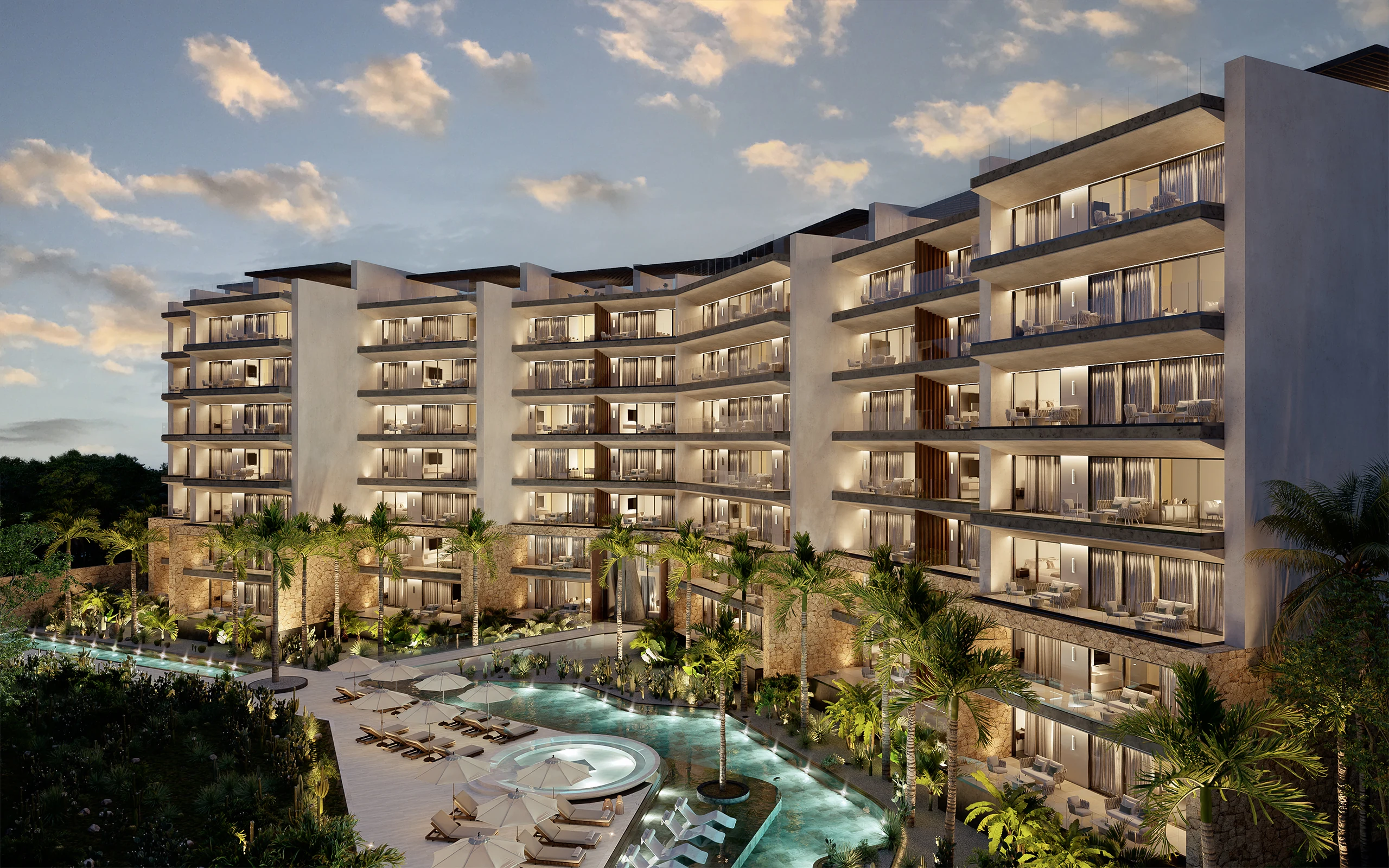
The amenity packages in modern Mexican condo developments have also become genuinely impressive. Rooftop pools with Caribbean views, co-working spaces, beach clubs, concierge services, and on-site restaurants are standard in the luxury segment. For buyers who want resort-style living without the overhead of managing a resort-style property, a well-amenitized condo delivers an experience that would be difficult to replicate in a private home at the same price point.
The trade-off is space and privacy. Even a generous 2-bedroom condo in the Riviera Maya will typically offer 90–130 square meters of interior space. You share walls, elevators, and common areas with neighbors. HOA rules may restrict pets, renovation work, or the hours during which you can host guests. For buyers who value autonomy and space above all else, these constraints can feel significant.
The Case for a Single-Family Home
A house gives you something a condo cannot: the feeling that the property is entirely yours. You can redesign the kitchen, add a palapa, expand the pool, plant a garden, or build a casita for guests — subject only to municipal building regulations, not an HOA board. For full-time residents and families, this flexibility is often decisive.
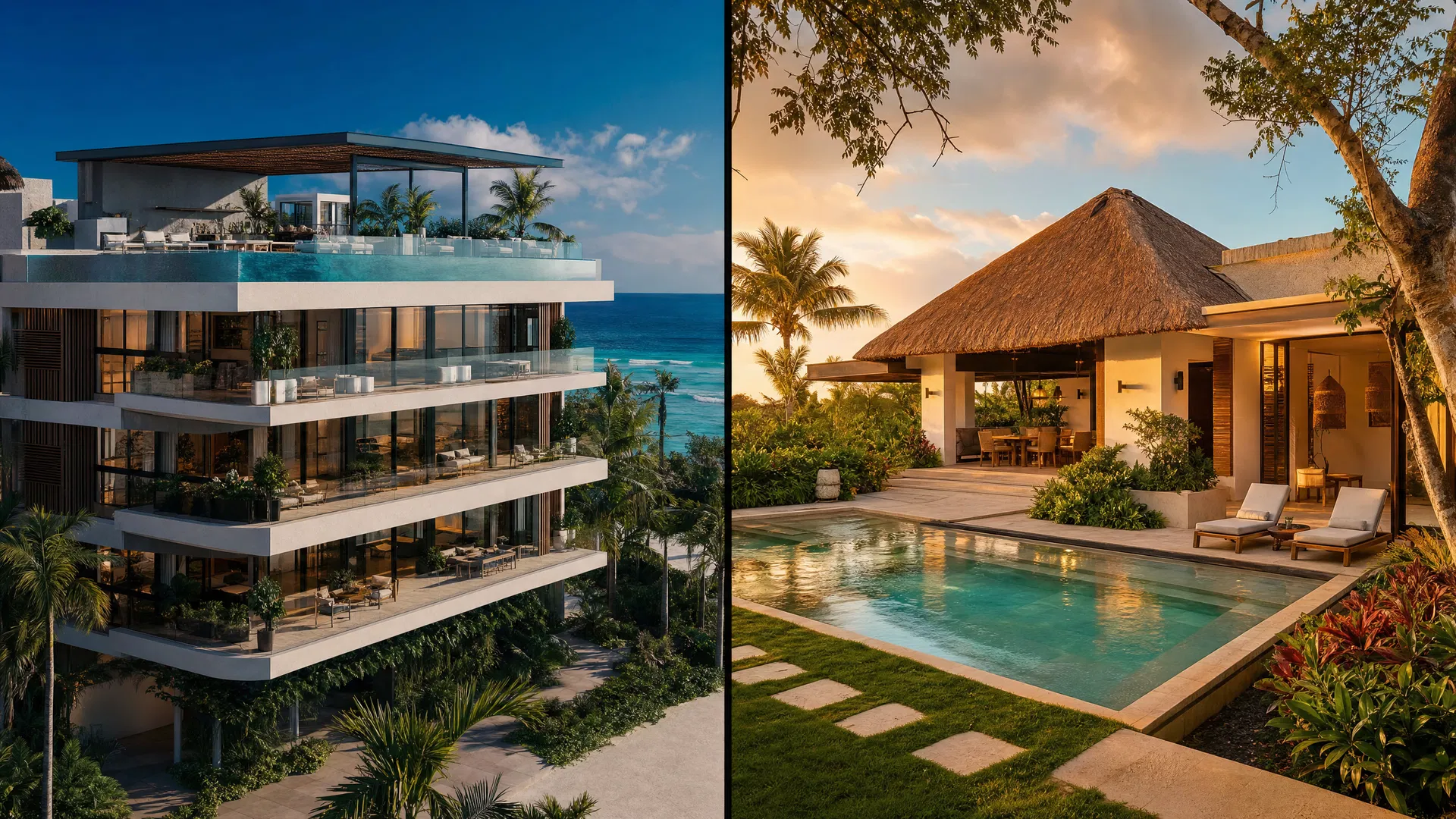
Homes also offer more living space for the money in most markets. A $350,000 USD budget that buys a 2-bedroom condo in a premium Tulum development will buy a 3- or 4-bedroom house with a private pool in a gated community in Playa del Carmen or a substantial colonial home in Mérida. For buyers relocating permanently or spending six months or more per year in Mexico, the additional space and privacy typically justify the higher maintenance commitment.
The security question is worth addressing directly. A common concern among buyers considering a standalone house is whether it is safe to leave unoccupied for extended periods. In practice, most gated communities in the Riviera Maya and Mérida have professional security staff, perimeter cameras, and controlled access that provide a level of protection comparable to a condo building. The key is choosing a property within a well-managed community rather than an isolated standalone house.
Market by Market: How the Decision Shifts by Location
The right choice also depends heavily on where in Mexico you are buying. The dynamics in Playa del Carmen are different from those in Tulum, which are different again from Mérida or Puerto Morelos.
Riviera Maya (Playa del Carmen, Tulum, Puerto Aventuras)
The Riviera Maya is condo country. The majority of new development in this corridor consists of condominium projects, and the infrastructure — property management companies, rental platforms, legal frameworks — is optimized for condo ownership. Buyers who want to invest in the rental market will find the widest selection of opportunities and the most established support ecosystem in the condo segment. Single-family homes exist and can be excellent investments, but they represent a smaller share of the market and require more active management. Browse properties in Playa del Carmen or explore Tulum listings.
Cancún
Cancún offers both high-rise condos in the Hotel Zone and residential houses in suburban communities like Puerto Cancún and Residencial Cumbres. The Hotel Zone condos are primarily investment vehicles — strong rental yields, high turnover, and a market dominated by short-term visitors. Residential houses in the suburban areas cater to families and long-term residents and offer more space at lower prices per square meter. The decision in Cancún often comes down to whether you are buying for investment or for living. View Cancún properties.
Mérida
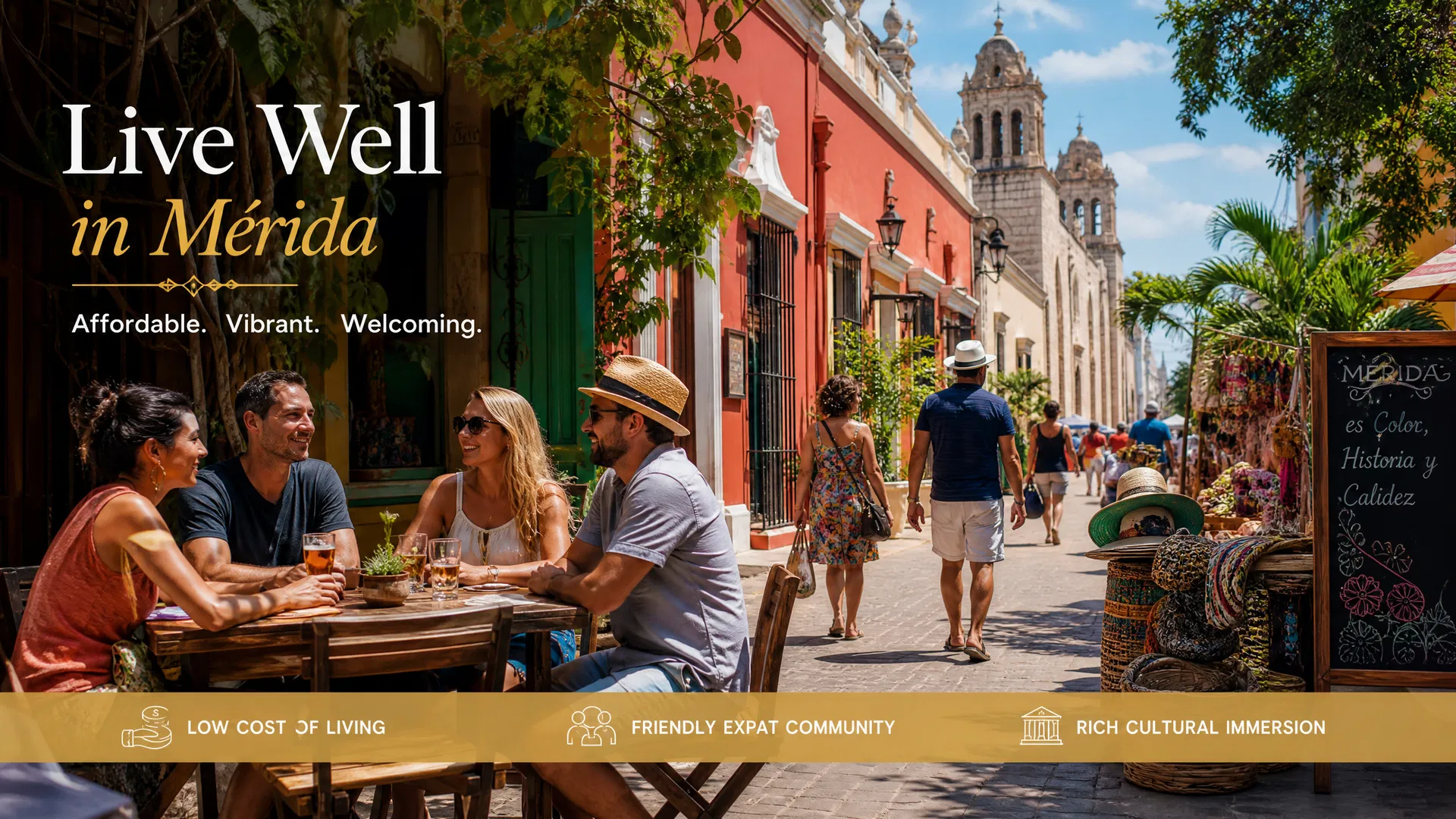
Mérida is the market where the house argument is strongest. The city's most distinctive and appreciating properties are its colonial homes — 19th-century mansions with high ceilings, interior courtyards, and original tile floors that cannot be replicated in new construction. Condos in Mérida are practical and affordable, but they lack the character and scarcity premium that drives appreciation in the historic center. For buyers who plan to live in Mérida full-time or who want a property that will hold its value through cultural and architectural uniqueness, a colonial home is the more compelling long-term investment. Explore Mérida listings.
Puerto Morelos and Akumal
These quieter communities between Cancún and Playa del Carmen attract buyers who want the Caribbean lifestyle without the density of the larger resort towns. Both condos and houses are available, and the market is smaller and more personal. Buyers here tend to be full-time or semi-permanent residents rather than pure investors, which shifts the calculus toward space and lifestyle over rental yield. See Puerto Morelos properties.
Pre-Construction vs. Resale: An Additional Layer
The condo-versus-house decision intersects with another important choice: buying pre-construction or buying an existing property. Pre-construction condos in the Riviera Maya have historically offered the strongest appreciation potential — buyers who purchase at the launch price and sell at delivery have captured gains of 20–40% in healthy market conditions. This model is almost exclusively a condo phenomenon; pre-construction single-family homes exist but are far less common.
For buyers who are comfortable with the risks of pre-construction — primarily the risk that the developer fails to deliver on time or at the promised quality — a pre-construction condo in a reputable development can be the highest-returning option in the Mexican market. For buyers who want to see and touch what they are buying before they commit, resale condos and existing homes offer more certainty. Our guide on Pre-Construction in Mexico covers the due diligence process in detail.
Making the Decision: A Framework
After weighing all of these factors, most buyers find that the decision clarifies around a few key questions. The table below summarizes the scenarios in which each property type tends to be the better fit.
| Your Situation | Better Choice |
|---|---|
| Primarily an investment, plan to rent most of the year | Condo |
| Part-time residence (2–4 months/year) with rental income | Condo |
| Full-time or semi-permanent residence | Home |
| Family with children relocating to Mexico | Home |
| Retiree seeking low-maintenance lifestyle | Condo (coastal) or Home (Mérida) |
| Buyer focused on Mérida's colonial architecture | Home |
| Maximum rental yield in Riviera Maya | Condo (pre-construction or well-located resale) |
| Privacy, outdoor space, and customization | Home |
| Entry-level budget ($120,000–$200,000 USD) | Condo |
| Larger budget with long-term appreciation focus | Home (Mérida) or Luxury Condo (Riviera Maya) |
There is no universally correct answer. The buyers who are most satisfied with their purchases in Mexico are those who matched the property type to their actual usage pattern rather than buying what seemed like the obvious investment or the most aspirational lifestyle choice. A condo that sits empty for ten months a year because the owner wanted a house is a worse investment than a house that is lived in and loved. Conversely, a house that generates anxiety about maintenance and security for an owner who is rarely there is a worse outcome than a condo that runs itself.
How Mexico Luxury Properties Can Help
Our team works with buyers at every stage of this decision. We can provide current market data for specific neighborhoods, connect you with property managers who can give you realistic rental income projections, and introduce you to legal professionals who will walk you through the ownership structure that makes sense for your situation. Whether you are drawn to a beachfront condo in Tulum or a colonial home in Mérida's historic center, the first step is a conversation about what you actually want from the property and how it fits into your broader financial picture.
Contact our team to discuss your options, or chat with us on WhatsApp for a quick consultation. You can also read our complete Buyer's Guide for a step-by-step overview of the purchase process in Mexico.